Dance Research Project Ideas for High School Students

Writer | Researcher | Education Consultant
by
Published:
May 26, 2026
Last Updated:
May 26, 2026
Table of contents

Key Takeaways

  • Dance research is accessible to students of all experience levels because meaningful projects can focus on analysis, comparison, or documentation rather than performance.
  • High school dance research projects fall into categories such as history, biomechanics, psychology, cultural identity, media analysis, and choreography, and the strongest projects focus on one category with a single, specific research question.
  • Primary data collection methods include video-based movement analysis, 1–5 Likert scale surveys, structured observation notes, and learning journals, which produce original data that can be analyzed alongside secondary research.
  • Projects that combine written work with a creative or visual output, such as choreography documentation, performance recording, or video analysis, are stronger portfolio pieces than written-only submissions.
  • A strong research question includes a specific aspect of dance, an observable outcome, and a defined group or context, for example, “How does structured ballet training influence body awareness and emotional expression in student dancers?” rather than a broad topic like “ballet.”

Quick Start: How to Pick Your Project in 3 Steps

If you’re not sure where to begin, this approach keeps your project focused without overcomplicating it too early:
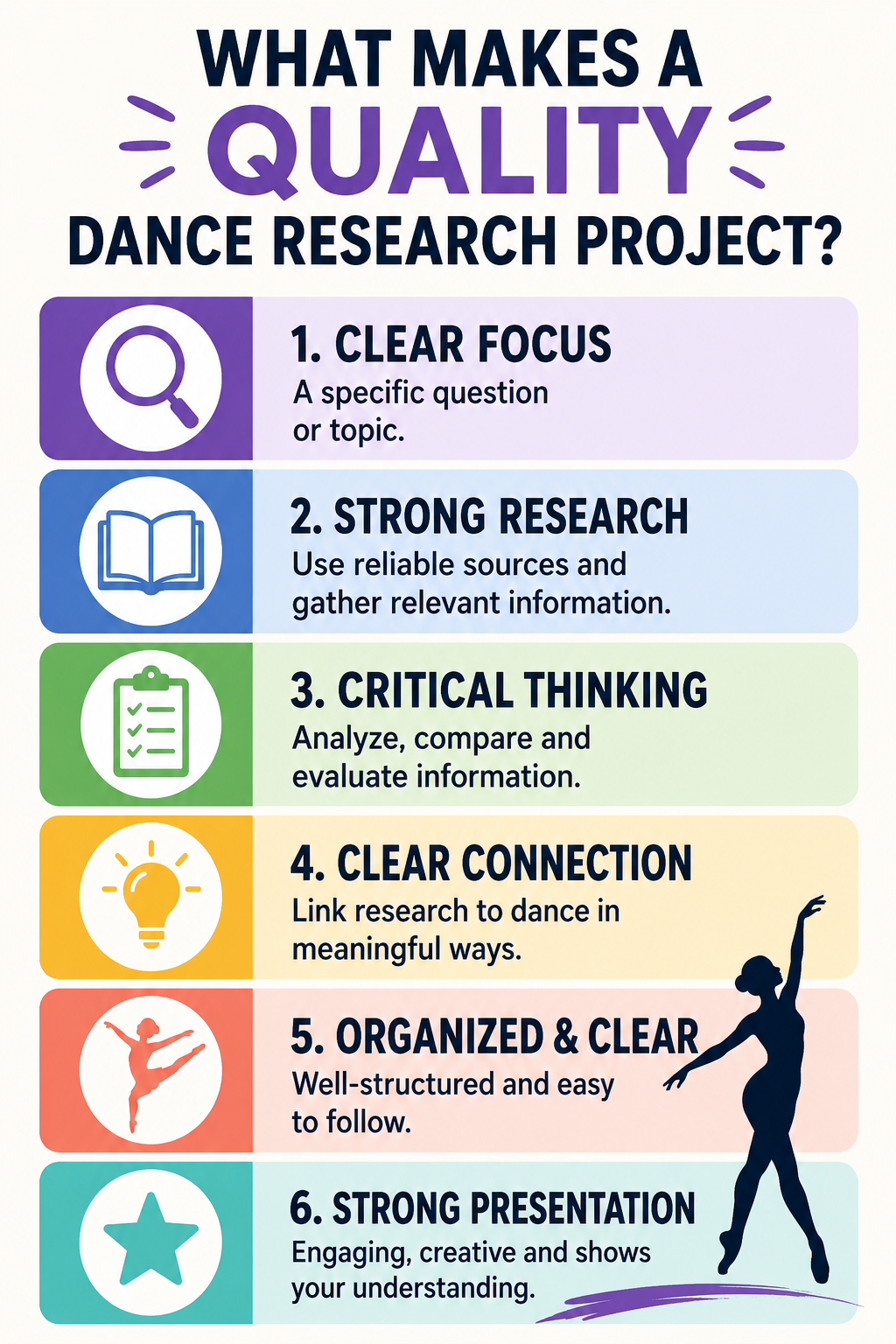
  1. Choose a category: history, science, psychology, culture, media, technology, choreography, biomechanics, mental health, education, activism, or performance analysis
  2. Turn your idea into a clear question: a unique inquiry
  3. Decide how you’ll present it: paper, video, choreography, or presentation

How to Choose a Dance Research Project Topic That Fits Your Goals

One of the biggest challenges when developing a dance research project idea is narrowing the topic down. There are so many possible directions to explore that it’s easy to get stuck trying to choose the perfect idea. A good place to start is with a topic that genuinely interests you. That might be the creative process behind choreography, the physical experience of embodiment, or how dance connects to cultural identity. From there, the next step is shaping the idea into a question that can be realistically explored through research and analysis. Strong research often includes peer feedback and reflection, as well as formative assessment (what you learn along the way) and summative assessment (what you present at the end). This mirrors how dance is taught in frameworks like the National Core Arts Standards.

Example:

• “Ballet” is far too broad.

• “How does structured technique training in ballet influence body awareness, discipline, and emotional expression in student dancers?” is much more workable.

Dance Styles Worth Exploring in a High School Research Project

Popular Dance Genres and Research Focus Ideas
Dance Style Focus Area Suggestion Example Project
Ballet Technique, discipline Classical training methods
Hip-Hop Identity, improvisation Cultural influence
Jazz Rhythm, performance Evolution in theater
Contemporary Emotional embodiment Expressive choreography
Tap Sound, rhythm Dance as percussion
Ballroom Partner dynamics Communication through movement
Folk / Traditional Regional identity Community traditions
Indigenous Ancestral storytelling Cultural and ceremonial practices

Dance History and Evolution Research Projects

Exploring dance history and evolution is one of the most straightforward ways to build a strong project. It gives you clear sources and a natural structure to follow. If you enjoy more structured writing, this type of project works especially well as a history research paper or annotated bibliography, where you can organize ideas and sources in a clear, academic way.

Examples:

  • Dance in prehistory and antiquity, including rituals in Ancient Greece and Ancient Rome
  • Court dance in 16th–17th century European courts and its transition in the 18th century
  • Romantic and Classical ballet in the 19th century
  • The emergence of postmodern dance in the late 1960s

Cultural Identity, Globalization, and Folk Dance Research Projects

Dance is closely tied to cultural transmission and social cohesion, which makes it a meaningful area to explore. Dance is often described as a universal language, and organizations such as UNESCO, the World Dance Alliance (WDA), and Ausdance highlight the importance of dance in education, cultural exchange, and community engagement, emphasizing its role in communication, identity, and intercultural understanding.

Examples:

  • Folk dance origin in places like Japan or Korea
  • How dance traditions are preserved in Australia or the United States
  • The impact of globalization on traditional dance, ethnic dance, and indigenous dance
  • The difference between cultural appropriation and respectful cultural exchange

Science-Based Dance Research Projects: Biomechanics, Physics, and Injury Prevention

Dance is both an art form and a physical discipline, which makes it a strong subject for scientific study. These projects connect dance with biomechanics, anatomy, physics, and sports science, making them especially useful for students interested in movement analysis, data collection, or injury prevention. Using tools like motion capture or video analysis can make this type of research even more engaging.

Examples:

  • Biomechanical analysis of jumps, turns, landing forces, and the physics of rotational movement in different dance styles
  • The role of proprioception, motor skill development, and spotting technique in balance and coordination
  • How training affects flexibility, strength, endurance, calorie expenditure, and overall physical performance over time
  • Common dance injuries, injury prevention strategies, and how repetitive movement impacts the body

Psychology, Mental Health, and Well-Being as Dance Research Angles

Dance is closely connected to psychology, learning, and emotional development. These projects often explore how movement affects the brain, identity, emotional well-being, and self-awareness. Even simple research tools, like short surveys using a 1–5 Likert scale, can help students collect meaningful data and analyze patterns in behavior and emotion.

Examples:

  • Dance and cognitive development in teenagers and young adults, including metacognitive skills and self-awareness
  • Measuring performance anxiety, somatic anxiety, and cognitive anxiety in dancers using tools like CSAI-2 (Competitive State Anxiety Inventory-2)
  • The impact of dance participation on self-confidence, body image, mood, and emotional well-being
  • Dance/movement therapy (DMT), emotional regulation, stress reduction, and the psychological effects of movement on mental health

Dance and Popular Culture: Media Analysis and Film Projects

The media strongly shapes dance and helps define what dance looks like in popular culture. These projects focus on representation, technology, audience influence, and the way movement is interpreted through film, television, and digital media. They often combine visual interpretation with semiotic analysis to explore meaning in movement and imagery.

Examples:

  • Dance in film and cinematography, including how camera work and framing influence how movement is perceived
  • Choreography in music videos and how movement, style, and visuals communicate cultural meaning
  • Social media choreography trends, including why certain dances spread globally or go viral
  • Screendance as a digital art form and its role in contemporary dance creation and performance

Creative and Performance-Based Dance Research Projects

Dance research goes beyond just writing. Some of the strongest projects come from creating, testing, and reflecting on movement itself. These projects often focus on choreography, experimentation, and the creative process.

Examples:

  • Group choreography projects with peer feedback, revision, and reflection
  • Improvisation experiments exploring movement vocabulary and creative decision-making
  • Performance ethnography documenting community, cultural, or social dance practices
  • Costume and visual storytelling projects that explore how design shapes meaning in dance

Dance and Society: Activism, Gender Representation, and Peacebuilding

Dance often reflects what is happening in the world around us, which makes it a powerful tool for communication, identity, and social change. These topics tend to feel especially meaningful when connected to real-world examples, cultural movements, or current events. Many projects in this area also explore how dance builds community, challenges stereotypes, and creates spaces for expression and representation.

Examples:

  • Dance and activism in different communities and social movements
  • How gender stereotypes and representation appear across dance styles
  • Dance as a form of peacebuilding, cultural connection, and community building
  • The role of dance in identity formation and nonverbal communication across cultures

Interdisciplinary Dance Research Projects

One of the most interesting approaches is combining dance with another subject area. This kind of work reflects arts integration, which is increasingly emphasized by organizations like the National Dance Education Organization (NDEO). Programs such as Black Box Dance Theatre demonstrate how interdisciplinary approaches can be applied in practice through performance, education, and community-based dance work.

Examples:

  • Dance + physics: motion, force, momentum, and balance
  • Dance + technology: motion capture, video analysis, and digital notation software
  • Dance + sociology: identity, culture, and community connection
  • Dance + education or psychology: learning processes, emotional development, and communication through movement

Choreographer Biography Projects: From Isadora Duncan to William Forsythe

Studying choreographers gives you insight into how dance evolves through individual creativity and innovation. As Martha Graham once said, “Dance is the hidden language of the soul.” That idea becomes clear when you look at how different choreographers approach movement. These projects can take the form of a written biography, a presentation, or even a performance inspired by their work.

Key choreographers to explore:

Notable Choreographers Across Dance Styles
Person Role Dance Style
Isadora Duncan Choreographer, Dancer Early Modern
Martha Graham Choreographer, Dancer Modern
Alvin Ailey Choreographer, Dancer Modern, Contemporary
Anna Halprin Choreographer, Dancer Postmodern, Experimental
Yvonne Rainer Choreographer, Dancer Postmodern
Merce Cunningham Choreographer, Dancer Postmodern, Contemporary
Rudolf Laban Choreographer, Theorist Movement Analysis
Jerome Robbins Choreographer, Dancer Modern, Ballet
Robert Joffrey Choreographer, Dancer Modern Ballet
Marius Petipa Choreographer Classical Ballet
George Balanchine Choreographer Neoclassical Ballet
Mikhail Baryshnikov Choreographer, Dancer Classical Ballet
August Bournonville Choreographer, Dancer Classical Ballet
Rudolf Nureyev Choreographer, Dancer Classical Ballet
William Forsythe Choreographer, Dancer Contemporary Ballet

Project Formats and Output Options for High School Dance Research

There’s more than one way to present your project, and it really depends on what you’re trying to show. The key is choosing a format that clearly communicates your ideas and what you learned.

Some common options include:

  • Research paper
  • Poster presentation
  • Oral presentation
  • One-page visual design
  • Video presentation (under 5 minutes)
  • Learning journal

Simple Tools and Methods to Analyze Dance for Your Project

You don’t need advanced equipment to create a strong project, but having a few tools definitely helps. These can make it easier to record, analyze, and present your work clearly. Even simple tools like your phone, basic editing software, or presentation apps can go a long way. The goal is to support your ideas, not complicate the process.

Tools:

  • Google Slides, PowerPoint
  • Motion capture software
  • Digital notation software
  • Databases like Web of Science, ScienceDirect, Taylor & Francis, Wiley

Methods:

  • Labanotation and Laban Movement Analysis (LMA)
  • Choreographic analysis
  • Qualitative movement analysis
  • Grounded theory
  • Systematic literature review (SLR) using PRISMA guidelines

How to Collect Data for a Dance Research Project

Once you have a topic, the next step is figuring out how to gather information. The strongest projects use simple, clear methods that connect directly to the research question. The key is to match the method to your question. If you’re studying emotions, surveys and reflections work well. If you’re studying movement, observation, and video are usually more useful. Keeping your approach simple will make your project easier to complete and much easier to explain.

15 data collection methods:

  1. Use a short survey with a 1–5 Likert scale to measure things like confidence, stress, or enjoyment
  2. Record and analyze movement using video for basic dance analysis
  3. Observe a class or rehearsal and take structured notes on movement vocabulary, spacing, or interaction
  4. Compare two dance styles or techniques and document differences over time
  5. Collect peer feedback on choreography and track how revisions improve the piece
  6. Keep a learning journal to reflect on your creative process and decision-making
  7. Conduct informal interviews with dancers, teachers, or classmates about their experiences
  8. Analyze a performance (live or recorded) using choreographic analysis or semiotic analysis
  9. Track physical changes such as flexibility, balance, or endurance over time
  10. Use before-and-after recordings to evaluate improvement in technique or expression
  11. Study audience reactions by gathering feedback after a performance or presentation
  12. Compare how the same choreography looks when performed by different dancers
  13. Analyze dance in media, such as music videos or films, focusing on meaning and presentation
  14. Document rehearsal progress to understand how choreography develops over time
  15. Use academic sources and reference other published research to support your ideas, build background knowledge, and compare your findings with existing studies

Dance Research Project Checklist: From Topic to Final Presentation

Throughout your research process, pause and check in with yourself using a few simple questions:

  1. Is my research question clear?

  2. Does my method match what I’m trying to find out?

  3. Are my sources reliable?
  4. Am I including something visual or practical to support my ideas?

Taking time to reflect as you go can make a big difference in how focused and polished your final project feels. When everything comes together, trust your work and share it with confidence, knowing you’ve built something meaningful from your own ideas and curiosity.

Final Note

The most effective dance research projects go beyond simply describing movement. They explore how dance connects to identity, science, and society. The projects that stand out most are the ones where students stay curious, experiment a little, and let their ideas evolve along the way!

For more inspiration, check out these Indigo Research blogs on Mentorship Programs to Publish Research and Fine Arts Passion Project Ideas.

FAQ

What grade levels are dance research projects suitable for?

Most dance research project ideas for high school students are ideal for grades 9–12.

How long should a high school dance research project take?

Usually around 4–8 weeks, depending on the scope.

Can a dance research project be done in a group?

Yes. Group projects (typically 4–6 students) work especially well for choreography and interdisciplinary topics.

What online databases are reliable for dance research?

Web of Science, ScienceDirect, Taylor & Francis, and Wiley are all strong starting points.

Do I need prior dance experience to complete a dance research project?

Not necessarily. Many projects focus more on analysis, research, and interpretation than performance.

What is the difference between formative and summative assessment in a dance project?

Formative assessment happens during the process (feedback, drafts), while summative assessment evaluates the final outcome.

Whether you're exploring choreography, movement psychology, cultural traditions, or the science of performance, dance research can open doors to meaningful academic and creative opportunities. At Indigo Research, students work with mentors from top universities and professional fields to turn their ideas into impactful research projects. If you're ready to take your passion for dance beyond the studio and into original research, explore how Indigo can help you bring your ideas to life.

Learn More
Learn More
About Co-Author
Logo on a white circle
Kelsey Ludeman
Kelsey Ludeman brings expertise as a Learning Strategist, Academic Success Advisor, Educational Technology Consultant, and Certified Teacher. She holds a B.S. in Education from Texas State University and develops impactful resources that empower students, parents, and educators. Her work focuses on advancing student success, leveraging technology, and providing guidance to help learners achieve their academic and career goals.
About the autor
Kelsey Ludeman
Kelsey Ludeman brings expertise as a Learning Strategist, Academic Success Advisor, Educational Technology Consultant, and Certified Teacher. She holds a B.S. in Education from Texas State University and develops impactful resources that empower students, parents, and educators. Her work focuses on advancing student success, leveraging technology, and providing guidance to help learners achieve their academic and career goals.
About the autor
Logo on a white circle
This is some text inside of a div block.

Whether you're exploring choreography, movement psychology, cultural traditions, or the science of performance, dance research can open doors to meaningful academic and creative opportunities. At Indigo Research, students work with mentors from top universities and professional fields to turn their ideas into impactful research projects. If you're ready to take your passion for dance beyond the studio and into original research, explore how Indigo can help you bring your ideas to life.

Learn More
Learn More

Whether you're exploring choreography, movement psychology, cultural traditions, or the science of performance, dance research can open doors to meaningful academic and creative opportunities. At Indigo Research, students work with mentors from top universities and professional fields to turn their ideas into impactful research projects. If you're ready to take your passion for dance beyond the studio and into original research, explore how Indigo can help you bring your ideas to life.

Learn More
Recent posts